
How to Drastically Cut Pool Maintenance Costs and Extend the Season to 6 Months? Discover the Secret of the Energy-Efficient PP Shell
Building a backyard pool is the fulfillment of a long-held dream of having your very own, private relaxation zone. However, for many investors, right before signing the contract, a very understandable shiver of anxiety kicks in. The main concern? Running costs. In an era of dynamically rising electricity, water, and chemical prices, online forums are flooded with horror stories about energy bills that can effectively kill any desire to take a dip. The truth, however, is that a modern, intelligently designed pool does not have to be – and shouldn't be – a financial burden.
The key to success is not giving up on your comfort, but rather betting on a carefully planned synergy of three elements: the perfect thermal insulation of polypropylene (PP), a state-of-the-art pool enclosure, and intelligent heating technology. Discover how we at PP-Pools build energy-efficient aquatic ecosystems that minimize ongoing expenses and allow you to swim in warm water from early April all the way through October.
The Foundation of Savings: The Innate Thermal Insulation of Polypropylene
Before we dive into modern high-tech gadgets, we need to look at the shell construction itself. The vast majority of heat in any backyard pool escapes in two ways: through surface evaporation from the water level, and through penetration through the walls and floor directly into the surrounding soil. In the case of traditional concrete pools, the ground acts as a giant, freezing radiator, ruthlessly "sucking" the heat out of your water. Concrete is a highly conductive material, which, in the context of trying to maintain a stable water temperature, is a catastrophic flaw.
This is exactly where the greatest technological advantage of polypropylene shines. As an advanced engineered plastic, PP naturally boasts a very low coefficient of thermal conductivity. The material itself immediately creates a powerful barrier against escaping degrees Celsius. At PP-Pools, we take this a step further – the exterior of our shells is additionally insulated with a thick layer of hard extruded polystyrene (XPS foam). This construction essentially mimics a thermos flask. The water heated during the day retains its temperature significantly longer, and nighttime temperature drops, even when the outside air gets chilly, are absolutely minimal. This drastically reduces the workload on your heating equipment, which translates directly into visibly lower utility bills from day one.
The Polycarbonate Enclosure: Free Heating and the Ultimate Shield
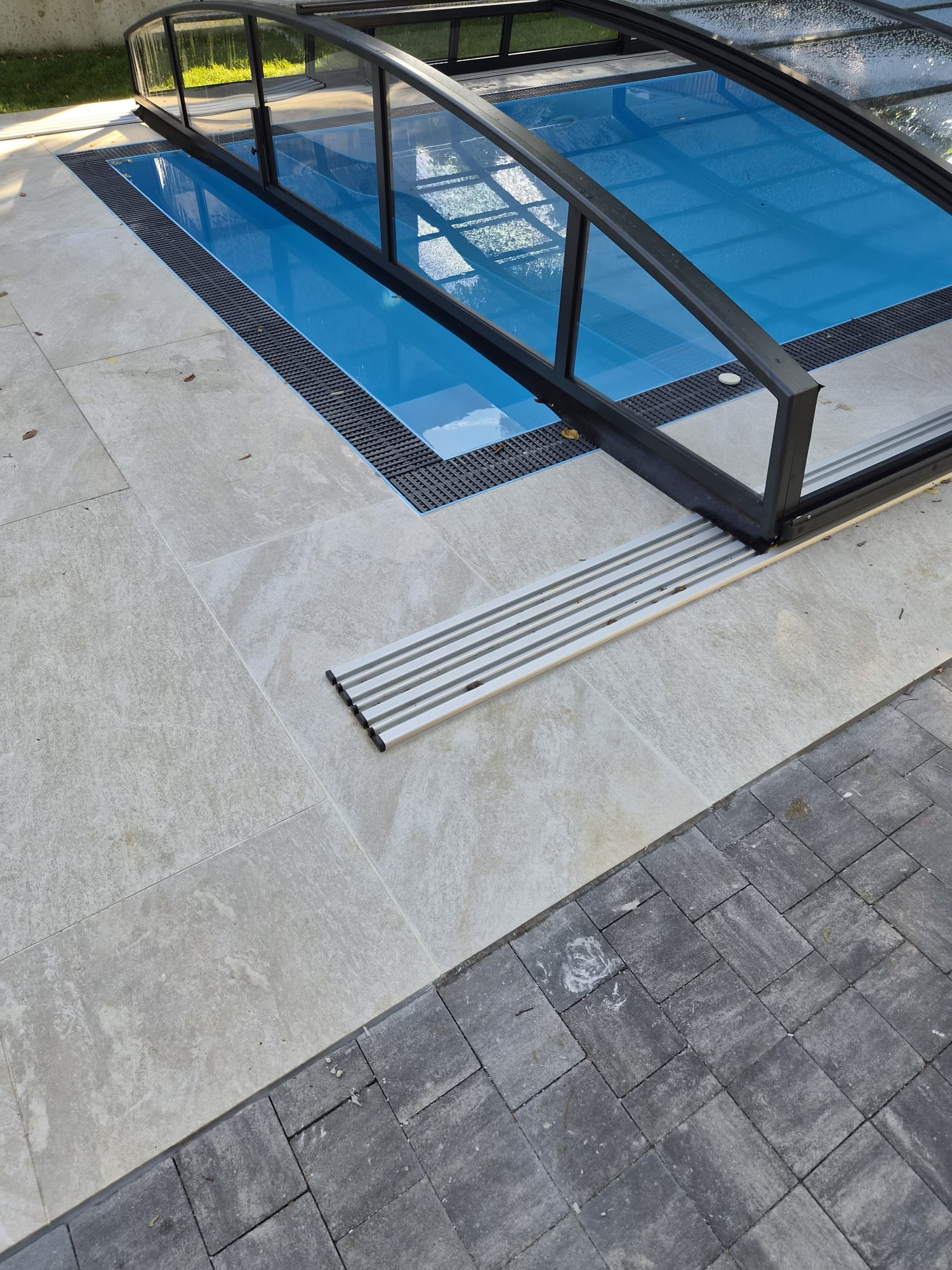
Even the most heavily insulated pool shell will not retain heat if we allow it to freely escape through the top. Industry studies relentlessly point out that surface evaporation accounts for nearly 70% of the total heat energy loss in an outdoor pool. The most uncompromising, effective solution to this problem is the installation of a telescopic polycarbonate enclosure. Why is this the fastest-returning investment you can make?
The enclosure operates on the principle of a classic greenhouse. The sun's rays effortlessly penetrate the transparent polycarbonate panels, aggressively heating the water and the trapped air inside, but the resulting thermal energy has no way to escape. Thanks to this greenhouse effect, on sunny—even chilly spring—days, the water heats up completely for free by an additional 4 to 6 degrees Celsius. At night, the enclosure acts like a thermal blanket, actively blocking the heat from radiating away. But the thermal aspect isn't the whole story. An enclosure drastically slashes your chemical consumption (by shielding the water from acid rain and UV rays that rapidly degrade chlorine) and completely blocks leaves, insects, and sand. Your filtration system works under far less strain, you perform backwashes much less frequently (saving precious water and the expensive heat stored within it), and instead of spending your weekends fishing out debris with a net, you simply enjoy your swim.
Inverter Heat Pumps and Smart Circulation
To become fully independent from the unpredictable whims of Central European weather, an active, automated heat source is mandatory. Old, power-hungry electrical heaters are rapidly becoming a relic of the past. The absolute standard in modern smart pools are Full Inverter heat pumps.
Why are they so incredibly cost-effective? A heat pump does not "produce" heat directly from electricity in a one-to-one ratio. Instead, it extracts ambient heat from the surrounding air (even when it feels cold outside) and transfers it directly to your pool water. The Coefficient of Performance (COP) in top-tier units hovers around 10 to 15. This means that for every 1 kW of electricity drawn from the grid, the pump can generate up to 15 kW of thermal energy for your water. Furthermore, the inverter technology allows the pump to dynamically adjust its power output – when the water reaches, say, 28°C (82°F), the pump doesn't clatter to a halt. Instead, it smoothly reduces its compressor speed, operating in a nearly silent maintenance mode and consuming only a tiny fraction of energy.
This entire system is perfectly complemented by a modern Variable Speed circulation pump. Instead of forcing the motor to run at maximum RPMs around the clock, an intelligent pump lowers the flow rate during nighttime hours or when cheaper electricity tariffs are active. Lower RPMs actually mean better filtration accuracy (as the water flows slower through the sand or glass media) and can slash the electrical costs of circulation by a staggering 75-80%.
To sum up, when deciding on a pool direct from the manufacturer, it is crucial to look at the costs from a multi-year perspective. A cheap, poorly insulated shell will act as a permanent drain on your wallet for decades. By choosing a polypropylene pool, equipping it with a polycarbonate enclosure, a Full Inverter heat pump, and automated filtration, you create a closed, highly efficient ecosystem. Such a "Smart Pool" guarantees an extended swimming season, fabulously low operational bills, and what matters most: absolute peace of mind for years to come.